
The traditional tentpole discount playbook looked like spreading modest discounts across a wide assortment of listings and relying on event volume to offset thinner margins. But on Amazon today, broad discounting can hurt profitability beyond what volume can make up for.
Prime Day 2026 showed this shift, as margin compression accelerated despite higher sales volume. During Q2 2026, when the event occurred, ordered revenue grew 13% year over year, while gross margin per unit fell 3 points to 17%, the weakest reading in at least six quarters, according to our data.
Brands should have this in mind as they plan for this year's holiday season. Protecting margin heading into Q4 requires a different CPG promotional strategy: holding consistent pricing in the weeks leading up to the event; using fewer, more deliberate promotions; and choosing the right deal format for each SKU.
Why doesn't broad discounting work for Cyber 5 anymore?
Amazon's deal eligibility makes broad discounting hard to sustain today. The marketplace looks at a product's recent selling price, not its everyday list price, so deals must be lower than the lowest price shoppers paid in the weeks leading up to the event. For Cyber 5, that window opened in late September, so even a routine markdown can become the baseline a Black Friday deal has to beat. (Luckily, Prime Big Deal Days prices are excluded this year.)
Brands that discount broadly and frequently can therefore back themselves into deep discounts. Consider a CPG brand that runs 15% to 20% promotions every month. By Cyber 5, those discounts have reset the price Amazon uses as its baseline, potentially forcing the brand to offer 30% or more off just to qualify.
Layered on top are holiday fees that Amazon charges for every deal, as well as ad cost increases as brands compete for the same shoppers. Prime Day 2026 showed how steep CPCs get, rising 37.3% from the weeks leading up to the event. The result is a double squeeze: the brand pays more to be seen while keeping less of every sale.
How brands can protect margin and deal eligibility
Cyber 5 shoppers expect big deals, and competitors will offer them, so brands can't afford to sit out the event. What they can do is decide which SKUs to discount, how deeply, and in what format, as well as how prices are set in the weeks leading up to Cyber 5. Concentrating discounts on a deliberate set of SKUs rather than the full catalog preserves price integrity across the rest of the assortment and protects margin headroom.
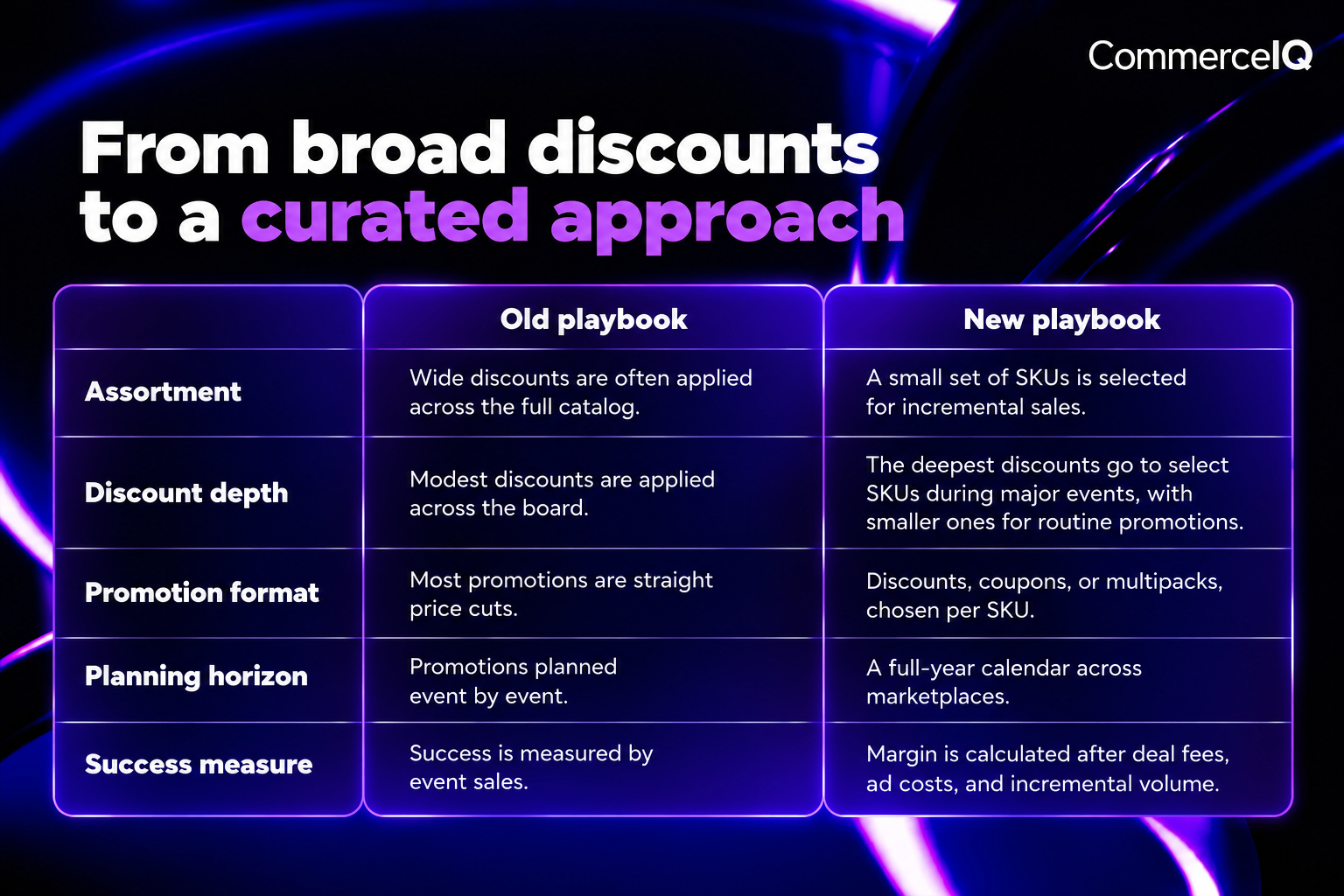
Reserve the deepest discounts for a few incremental SKUs
Only the SKUs that drive incremental sales, can support volume spikes with sufficient inventory, and can compete on price with competitors should receive deep discounts during Cyber 5. In the weeks leading up to the event, brands should keep routine promotions modest and within Amazon's deal-eligibility requirements. This will preserve enough capacity to offer 5% to 20% discounts, or more, when Cyber 5 arrives.
Use coupons and multipacks to move volume without lowering the baseline
When designing a promotion plan, in addition to discount depth, brands should also consider how deals are presented to shoppers. Coupons and multipacks can drive sales without raising the ceiling on future deals, making them a useful option for SKUs a brand plans to feature during Cyber 5.
Here's how each deal format affects the price baseline:
- Coupon: Applies at checkout after the shopper clips it, so the product's displayed price remains unchanged and future deal eligibility is protected.
- Multipack or bundle: Creates a separate offer, often under a new ASIN, at a lower per-unit price. This can drive volume without lowering the single-unit product's price history.
- Straight discount or Lightning Deal: Lowers the product's selling price, which makes future deals harder to qualify for. These offers are therefore best reserved for main tentpole events.
Set Cyber 5 pricing now, then use it to plan next year
Tentpole pricing requires one cross-functional, cross-channel view. Finance should approve deal margin after fees and ad costs; pricing should set discount depth and pre-event prices; sales should check trade spend and minimum advertised price (MAP); and retail media should align ad spend with the final deal schedule. Those decisions also need to account for other marketplaces, such as Walmart and Target, since a markdown in one channel can trigger price matching or MAP conflicts in another.
After Cyber 5, use the same framework to build a full-year promotional calendar that protects future event pricing, rather than planning each promotion and event in isolation.
Checklist for brands to protect margin during tentpole events:
- Review price baselines now: Audit price histories, confirm current rules in Seller Central or Vendor Central, and coordinate deal calendars across marketplaces.
- Curate SKUs and tier discounts: Save the biggest markdowns for a few incremental SKUs at the main event.
- Choose the format per SKU: Use coupons and multipacks to protect future baselines, and save straight discounts for the main event.
- Validate margin before and after: Confirm profitability with finance before a deal goes live, then audit results once attribution windows close.
- Set live thresholds: Agree in advance on which metrics will trigger a mid-event change.
How brands can catch failing promotions during Cyber 5
Even with pricing set weeks ahead, Cyber 5 moves quickly. A deal that performs well on Black Friday can lose momentum as competitors change their offers, and Amazon's reporting can lag by one to two days. That delay can leave brands without enough time to spot underperforming deals and adjust them before the event ends.
An agentic retail platform can help teams react in real time. Say a Lightning Deal on a hero SKU starts strong but then slows within hours as a competitor deepens their discounts. The platform can flag the drop in sales and share of voice against pre-set thresholds. It can then recommend or, with human oversight, execute a response, such as shifting ad budgets toward stronger-performing deals or flagging a promotion that's draining margin so the team can cancel it early.
CommerceIQ gives brands visibility into promotional performance and the ability to execute, helping teams act quickly during tentpole events like Cyber 5 and use those insights to plan for the next.